- 3 Posts
- 23 Comments
Joined 3 years ago
Cake day: June 13th, 2023
You are not logged in. If you use a Fediverse account that is able to follow users, you can follow this user.


 1·3 years ago
It’s pretty good! I have only listened to a few episodes so far. I have tended to skip through the first 30-40% of the episodes, which has been a lot of discussion of the guest’s academic training and career, which isn’t very interesting to me personally. After they finish talking about that, I usually enjoy the rest of each episode!
Wow! Good luck getting to 100! What city are you in?
I heard about the orchid project on this podcast episode, a pretty interesting interview: https://www.indefenseofplants.com/podcast/2022/5/29/ep-371-the-million-orchid-project
 3·3 years ago
This is pretty out of the box. It’s just something we’ve wanted to do for awhile and we’re using the 4th of July as an opportunity:
DIY nacho bar: everyone gets a cookie sheet, there’s a table with various chips, cheeses, and toppings, and you take turns under the broiler
DIY sundae bar: same thing, but ice cream (and no broiler!)
What a cute idea! How many have you given away so far?
Reminds me a bit of the Million Orchid Project, where plants are given to community members and schools to plant out in their community https://fairchildgarden.org/science-and-education/science/million-orchid-project/
I love how paprika will extract the ingredients and cooking instructions from a recipe site so I don’t have to hunt through a page that’s a mile long!
It looks terrific! I’ve never seen one of those growing so rambunctiously. Why do you think your succulents usually get leggy?
Wow! I’ve never seen one in bloom. To be honest I never even considered they could
So satisfying to bring a plant back from the dead! Congratulations! The color is really pretty in the newest picture. Does it normally change color throughout the year or is the color change a reaction to the stress?
Love it! They look so fragile during that process. Like a butterfly emerging from its chrysalis
Beautiful! The waxy case makes them seem so precious and special to me.
I haven’t ever gotten them to re-bloom on purpose. I just keep them around for years and periodically they do. Some re-bloom much more often than others. I got a few orchid books out of the library recently to take a more informed approach. It seems like many different factors can influence re-blooming and that it depends on the genus/species. Temperature changes like you mentioned, also day length, amount of light, even pressure changes with the weather! Good luck with your orchids.
I know what you mean! To be honest I get pretty excited about new roots too haha, all new growth is exciting
Here is a picture from today showing the current state of the spike, along with an emerging root!
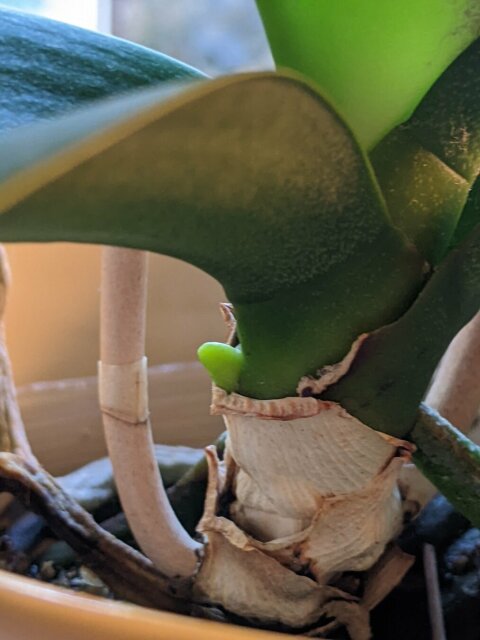
Great question! I know for sure because the picture is from a couple of weeks ago and by now it’s clearly a flower spike.
I had your same question when the growth was at the stage shown in the picture. I looked up how to tell the difference between flower spike and root. What I learned was that two signs of flower spike are:
- Located right below the middle of where a leaf attaches to the stem, because that’s the location of a node that can become a flower spike. Roots can come from a greater variety of locations around the stem.
- Shaped like a mitten, in other words the growth is slightly asymmetric. I believe the thumb is a forming node and the fingers part is where the spike will continue growing. The mitten shape is not present in this image, it developed a day or two later. In contrast, a developing root is fully symmetric/round.
There may be other signs too or these may be incorrect, please share if you know them!
Great picture!
Awesome, do you know what variety they are? They look to be thornless.
In my neck of the woods Himalayan blackberries are a super invasive pest that have to be fought tooth and nail, as other commenters mentioned. But the thornless varieties are nice!
Love them! I always like to buy the weird looking carrots when I’m shopping
Wow so cool! I wish I lived in a climate where growing outside on trees was possible. I live in Seattle, not exactly prime territory. Although I would like to learn about orchids native to the area.