

2·
2 months agoLooking at this, all I can hear is “WAZZAAAAP!” like in the Budweiser commercial.
Looking at this, all I can hear is “WAZZAAAAP!” like in the Budweiser commercial.

Where do I find this dragon launcher? I searched for it in the Play store and didn’t see it.
Jew Mexico, on the other hand, hasn’t really been feeling the love lately. 😢

I’m here to see if anyone else said this. 100% agree!
I need to know if the male affection and hand sniffing continued to escalate!
I know this isn’t exactly what you were asking for, but this looks promising for people that want what essentially is the anti-cybertruck:
I literally got the same message a few days ago and immediately showed my wife. She laughed a little TO hard if you ask me, but whatever. Lol
Mine is from the 1996 anime film X. It is based on a CLAMP manga and goes much harder than the poster would lead you to believe.
The soundtrack complements the tone perfectly with its experimental and unsettling atmosphere.
I’m not sure if anybody said it yet, but I think a simple figure embracing something would be pretty universal for a “save” and then delete would be that figure rejecting something by putting his hands up and turning its head.
The cards take a beating and before Amazon existed it was much harder to get replacements. We tried regular playing cards, but that only works if every deck has different backs for scoring purposes. I think there was another issue in practice, but that was the main frustration.
Legretto
I was introduced to the game by an Austrian woman I dated in my 20s and 25 years later remains at the top of my list of party games.
Ligretto is a card game for two to twelve players. The game in its current form was designed by Michael Michaels and published in 1988 by the German company Rosengarten Spiele. Since 2000 the game has been published by Schmidt-Spiele of Berlin, Germany. - Wikipedia>

Yeah, it’s cheap. Sorry for the lack of clarity and brevity. Lol.
I couldn’t get any faster than about a minute and a half using the beginner method so I decided to try learning CFOP. At first I got way slower because there are more algorithms to remember but I saw how some others have modified it a bit to make it simpler and practiced when I could (i.e. watching TV like you lol) and now I can solve it in about a minute.
That’s clearly not competitive in any way but I’m really just competing against myself so I’m happy with any Improvement. That’s light years better than where I started and to people that don’t know there are 11-year-olds online doing it in 8 seconds, my one minute is pretty impressive! 😂 Happy cubing, my friend!
I got a couple Rubik’s cubes for my kids a few years ago for nostalgia and they didn’t want anything to do with them once they realized it wasn’t easy to fix.
I tried to encourage them to keep plugging at it but they said “how am I supposed to do this if you can’t?” I realized they had a point so I downloaded an illustrated book that takes you step by step through the beginner method, and after a couple of hours I solved it!
I felt like I had climbed Everest and the first thing my kids did was scramble it again as soon as I showed them. That was the beginning of me getting into cubing as a hobby, and I have to say it’s one of the LEAST expensive hobbies I’ve ever been a part of!
Like with any hobby there are entry-level cubes and then enthusiast cubes that are more feature-rich and expensive. But the Delta between the two is surprisingly small. The cube that I use the most is one that has won world records and it was about $20 I think?
I have bought several variations of the 3X3 and other form factors. I have also bought a few as gifts as well as a Bluetooth connected cube with an accompanying robot and I don’t think I’ve spent more than $300-$350 total for the lifetime of the hobby.
That said you could easily be competitive with a world class cube, a timer, a mat, and some “Cube Lube” for maintenance all for about $60-$80 no prob. It’s about the only hobby I have my wife fully endorses, lol.
I don’t see how because a foot fetish is an attraction to someone else’s feet, as in “feet that don’t have a neighboring nerve connected to the same part of the brain that controls said foot pervert’s dong.”
This is actually science related to the electrical impedances of nerve and brain tissue.
The connection between foot nerve stimulation and genital stimulation is a physical one that can (and has) been measured and reproduced. This response is nearly universal and affects men and women, unlike a foot fetish.
I think a better explanation for the fetish is that feet are a part of the body that is often covered and seen as generally dirty, giving it a taboo allure other non-sexual parts of the body don’t usually have, but that’s less neurology and more just my opinion. Lol
Edit: added the usually
No, but the closeness in orientation explains why foot rubs are erotic. Stimulation of the foot and toe region of the brain will affect the neighboring genital region causing arousal.
Aw man. No dice. For some reason I thought I remembered seeing brain dicks, but I was wrong.
This painting doesn’t even mention genitals!
The book is from 1953, so maybe that’s why.
Edit: wasn’t able to share photo before but I just took a new one and it worked.
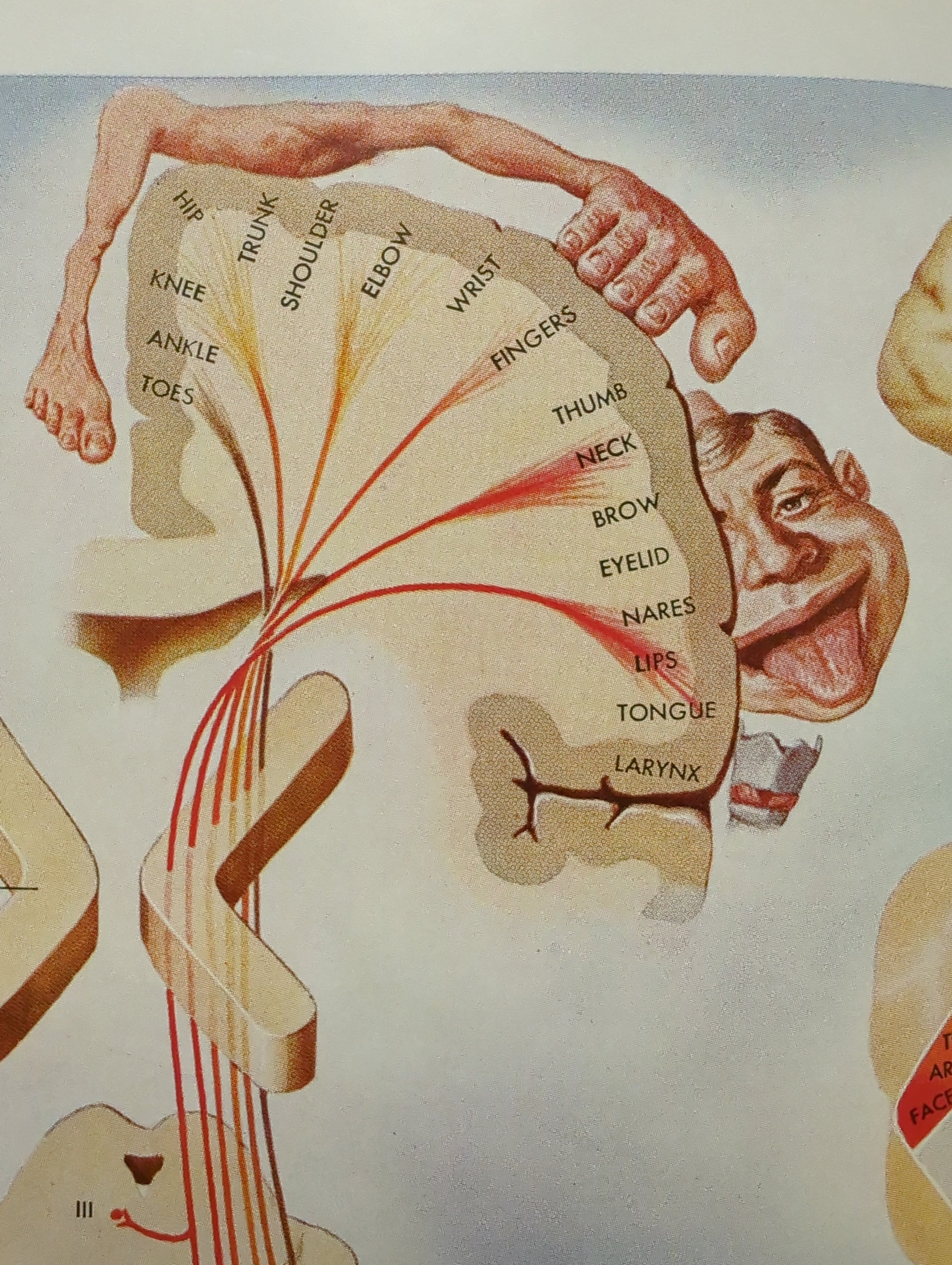
I’m an EEG/Sleep technologist and an older coworker just gifted me an ancient book with a similar image inside that may have the genitals. I’ll check when I’m back in my office and upload if applicable. 👍🧠🍆

I believe it’s a combo of sunlight and distance according to experts.
Ok, I admit my last reply was a little scattered because I wrote it over the course of half a day, so I’m going to attempt to deescalate things and do a better job of explaining my perspective without getting so lost in the weeds.
Feel free to disagree with me on this point but it sounds to me like we have a misunderstanding about what atypical sensory processing is. Atypical sensory processing is a symptom of autism and may be associated with ADHD, but they are not types, or examples of, atypical sensory processing. Atypical sensory processing is it’s own stand alone issue and is not always related to ADHD. Furthermore, it’s just one part of the spectrum of issues that need to be identified for a formal autism diagnosis, which is why I was adamant that insisting that one must mean the other is present, in my opinion, is inappropriate and misleading.
I would also like to argue that using the proper terminology is important in making sure that data isn’t misunderstood. I feel that it’s just fine to note what the studies findings are, which is that screentime can be damaging to young minds, without evoking ADHD and autism unnecessarily.
I do want to apologize for making an unnecessary call to authority and I can see how that may have come off douchey. The point I was attempting to make by doing that is that researchers can’t always be trusted not to put their thumbs on the scales in their research summaries knowing that people will jump on certain buzz words and run with it to make their study get more clicks. I know because that’s happened with studies I’ve been a part of (again, I realize you have no reason to believe me. Just explaining what I was attempting to convey.) Thankfully, they have to be more careful with the actual data documentation, but even then depending on the publication there’s wiggle room. Because of this fact, I think it’s important that we read less into these types of studies and not more. That’s why I suggested that even though autism is mentioned in the summary, I don’t feel it’s presence represents a direct relationship because the study data itself does not support this association. The summary even says so. I think the only reason the word is included is to encourage articles like the one you originally posted to make unverifiable claims for them.
Finally, I brought up the Wakefield thing because despite being discredited years ago, millions of people still believe that there’s a connection between vaccines and autism because of the fact that pop science magazines don’t get fact-checked the same way clinical research journals do. They can say a study says whatever they want, whether it does or not, and 99% of people are only going to read the headline and assume it’s the truth without looking any deeper.
I understand that in this particular instance, no one is being physically harmed because of what I see as a false equivalence, but I do think it can be harmful if someone were to read this article and then look down on a parent of an autistic child because they think they got that way from sitting in front of too much television. That’s clearly not how autism works but you wouldn’t know that by reading this article.
I hope you have a better understanding of where I’m coming from and for what it’s worth, I wish you well in life.


Yes. I got two for my oldest children as Easter gifts. They scrambled them and after a few minutes of frustration, left them lying on the floor.
I encourage them to keep trying to solve them but they told me " what chance do I have if you can’t even do it?" I thought about it and realized that they were right.
I downloaded a PDF of a Rubik’s beginner guide I found online and solved it in about an hour. I felt like I had conquered the world!
While bragging to my wife I saw my youngest scrambling it again and my heart sank. My wife saw my reaction and said “what’s the big deal? Don’t you know how to do it now?”
I explained that I had essentially cheated, but had to admit that the steps weren’t as hard as I had imagined. I decided then and there that I was going to learn and eventually memorized the beginner method!
After getting a speed cube and lots of practice, I started averaging about 2 mins. After watching some videos online I decided to give the CFOP method a try. It felt like starting over but I was patient and now I can do it in close to 30sec.