- cross-posted to:
- technology@lemmy.world
- news@lemmy.world
- cross-posted to:
- technology@lemmy.world
- news@lemmy.world
You must log in or register to comment.
deleted by creator
It’s definitely a process that will yield some false positives, if for no other reason than Romans were notorious users of abbreviations to save on resources which can make things ambiguous. But from an object cataloguing mountainous backlog perspective? fuck yeah. Scan all the tablets everywhere, and then pick out the super interesting ones for human review.
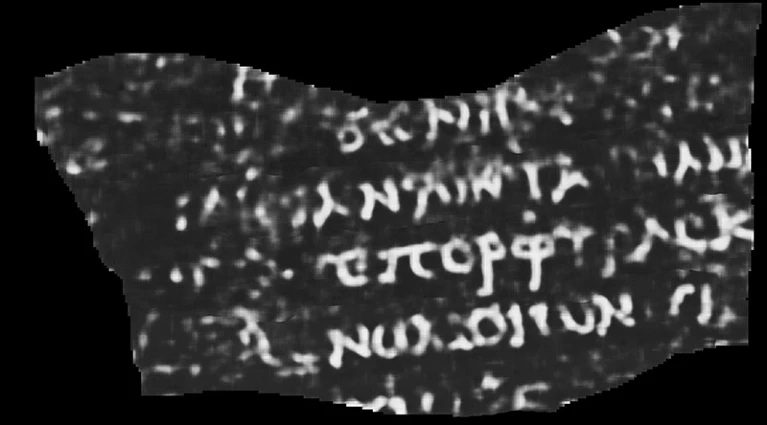
I’m a little bit surprised that all they got from that section of text was the word “purple”. I mean it’s a pretty amazing restoration, it looks like there’s a whole lot more than one decipherable word there!
Lol I missed this image entirely.
I can definitely see the word porphyry here, which is super cool, but I forgot that the Greeks and Romans had another annoying resource-saving technique of not putting spaces between words or sometimes just using interpuncts•like•this. We didn’t start using word spaces in texts until centuries later.
I can get behind continuous writing when the word boundaries are otherwise obvious, but it’s super irritating for foreigners hundreds of years later trying to make out the details.
The researchers got fucking lucky this person had nice educated handwriting, at least. Sometimes you just get shit like this grocery list instead.
Am I the only one who remembers the Buffy episode where they made the computer read some ancient texts and it summoned a demon?
Do you want the clash of the titans? Because that’s how you get the clash of the titans.
I could definitely use a mechanical bird friend.
Any chance this could work on the Indus Valley script, Linear A, or Rongo Rongo script?