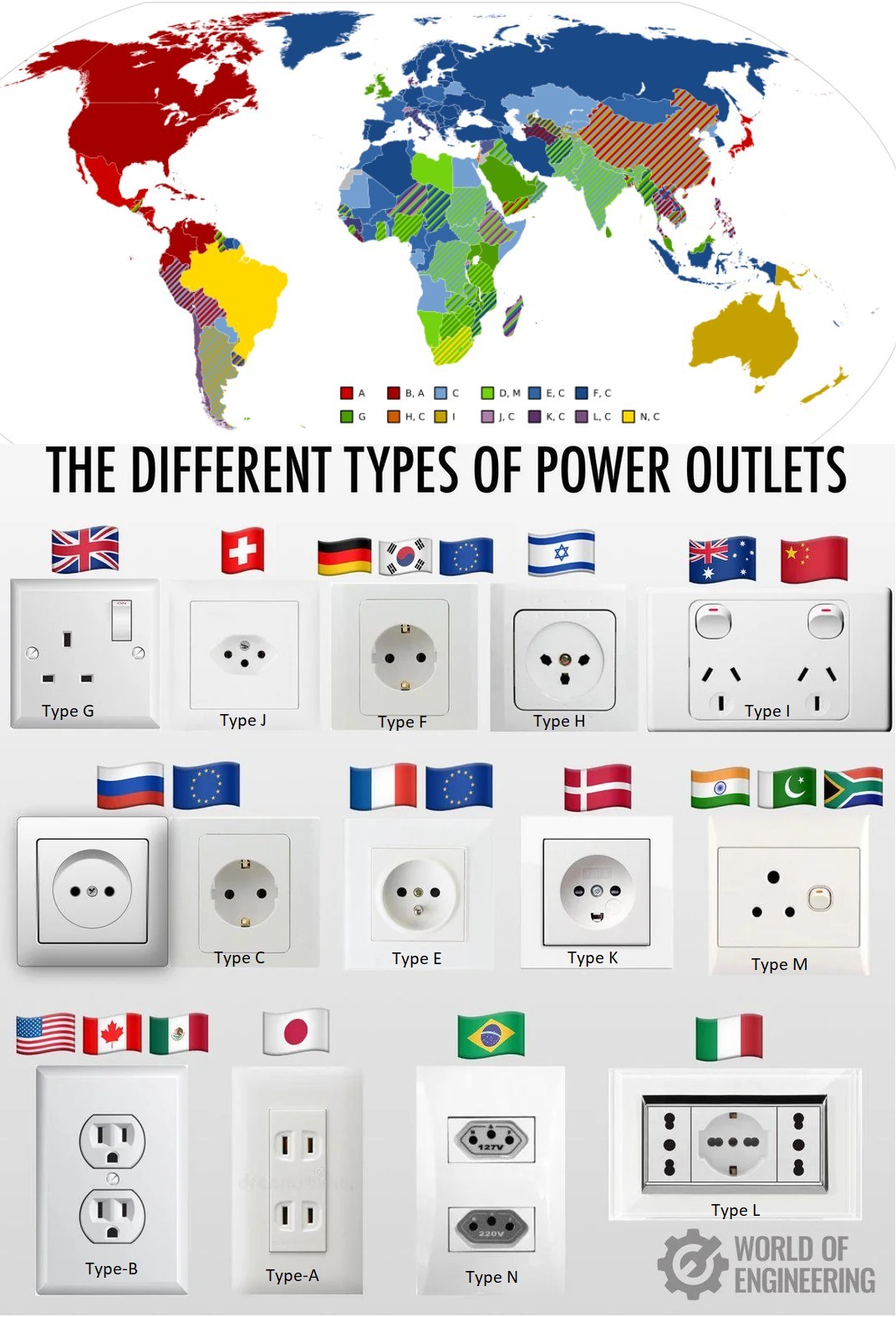

The British one. It has a switch and a fuse, and later versions have age-verification so your kids can no longer plug in your adult toys.
Had me in the first half. Well played.
And your adult toys must be licensed, of course. To protect the kids.
Its important you don’t allow them access so you need to keep them on your person in a place thats very hard to access. So hard.
My toys are wireless…
You’ll need a broadcasting licence for that, mate.
In my opinion it’s Type-F
Because:
- It’s bi-directional
- It’s grounded and ungrounded plugs use the same socket
- It’s already widespread (50+ countries) source
- Your fingers can’t touch the live wire as you’re plugging in a wire
- It’s recessed
- Low footprint
- Accepts Type-C
Accepts Type-C
It took me a few seconds to realize you werent talking about shoving a USB Type C plug into there.
I see a lot of your comments about F being objectively same or better compared to G. The only thing I’d throw into the mix is the socket switch feels so logical, I’m really surprised it’s not more standard.
High frequency use case: I don’t need my microwave on all the time showing me the time, so I switch it off at the socket unless I’m using it
Low frequency use case: before going on holiday I switch all the electrics off at the sockets
Bi-directional is a double-edged feature.
It means that there is no reliable way of identifying line and neutral wire, which requires more complex double switches downstream.
Also, F is unnecessarily clunky and big and hard to make a weather-proof version of because of the complex shape.
Because:
- It’s bi-directional
This is very convenient, and not a problem in 99.9% of cases, but there are some devices where it’s important to not have the hot and neutral wire swapped
What’s the difference of C and F type?
The type-C shown in the picture is also not the only form it has and maybe partly misleading, the plug usually is significantly smaller and flat, and power strips can feature multiple of those in less space.


It’s bi-directional
That’s bad.
Why? It doesn’t make any difference with AC
The actual electrical device can be designed such that it depends on exactly which direction is live and which is neutral.
Imagine a circuit loop that, as you follow along the circuit, has an AC power source, then a switch, and then the electrical appliance, leading back to the AC source it started from.
If you design the circuit so that you know for sure that the live wire goes to the switch first before the actual load, then your design ensures that if there is a fault or a short somewhere in the appliance, it won’t let the live power leak anywhere (because the whole device is only connected to the neutral line, not the hot live voltage that alternates between positive and negative voltage). It’s safer, and is less likely to damage the internals of a device. Especially if someone is going to reach inside and forgets to unplug it or cut power at the circuit breaker.
In practice tons of outlets are wired the wrong way around.
F actually has a convention for the socket, which is probably ignored even more often, but I would never trust live and neutral not to have been swapped somewhere regardless of outlet.Just forcing plug designers to consider live/neutral being randomized in a very obvious manner might be safer in the long run than working on a partially broken system where someone manufacturer might be fooled into trusting it.
It’s obviously the one in the country I live in. All the others that I have had zero experience with are from Satan.
I would argue that neither of the plugs shown in the picture nor those mentioned by others are the best.
Ignoring current adoption, I think that IEC 60906-1 is the best plug. It is very similar to the Swiss plug and was intended to, at least in the EU, replace other plugs. It has quite a few advantages over the other plugs. It is rated at 16 A, has a compact form factor, is polarised, and has almost all the common protections except fuses (which are pretty much useless anyway). Currently it only is used in South Africa without major changes to the plug.
Compared to the Schuko (Type F):
- Much smaller. You can fit three plugs in the same space as a single Schuko plug (similar to Swiss triple outlets).
- It takes less force to plug in. Above 2.5A, Schuko plugs require a lot of force to plug in and pull out. To some extent, this is actually good for safety, but I would argue that, in the case of Schuko plugs at least, it’s too much
- It is also easier to plug in without seeing the plug since it isn’t round. Everyone who has tried to plug in a Schuko plug without seeing the holes knows how difficult it is
- It’s polarised/directional. In some very specific cases, there is a security advantage to using a polarised plug, but I think it’s also a hassle to only be able to plug in a plug one direction. It also fits Europlugs (the thin, small plugs with only two pins that are very common in Europe, e.g. on phone chargers)
Compared to (Typ G)):
- Wayyy smaller
- Not a stepping hazard
- Rated for 16A (instead of 13 A)
- No Fuse (Again, pretty unecessary)
Regarding three-phase power, I would argue that Swiss type 15 (10A) and type 25 (16A) plugs are the best. These are really cool because while beeing the same size as Schuko (Typ F) plugs, they can transfer three-phase power (so 11 kW; 230 V / 16A on all three phases). They also fit standard Swiss single-phase and Euro plugs. This makes plugging in large appliances like electric stoves much easier than in other countries.
I would find it quite cool if most countries switched to one common plug, and I think IEC 60906-1 would be best for that. It would also be possible to build hybrid sockets for many common plugs during the transition phase.
After making this post, reading all the comments and doing even more research. I have to say I 100% agree with you.
I’m glad.
Maybe it’s unreasonable but I still hope that maybe countries will decide to switch to this connector.
The large amount of different, outdated standards definitly are a safety risk and hassle, even within the EU (e.g. a Schuko Typ F plug can be plugged in in Denmark but then it has no ground connection. Which is a common thing people there do).
So it would be pretty great to have this be the new common connector in all 220V-240V 50 hz countries.
Is not Type N (used in Brazil) an implementarion of IEC 60906-1 without any major change?
The brazilian plug is sadly a bit different. The biggest changes are that it has a different current rating. There is a version with 10A and 20A. It also allows for pins to completely be made out of metal which is a security hazard.
So it is quite similar but not identical.
IEC 60906-1 That is not a reversible plug which is annoying at times.
It takes less force to plug in. Above 2.5A, Schuko plugs require a lot of force to plug in and pull out. To some extent, this is actually good for safety, but I would argue that, in the case of Schuko plugs at least, it’s too much Hmm, I get what you mean and this can be an issue and it’s probably the reason why plugs without grounding exist since they are easier to pull out.
It is also easier to plug in without seeing the plug since it isn’t round. Everyone who has tried to plug in a Schuko plug without seeing the holes knows how difficult it is Never had this issue
I didn’t even know there are different three-phase power plugs, but then again you rarely need those compared to the normal plugs
Rarely? You don’t have a stove, an oven, a dishwasher?
My microwave/oven and my dishwasher are on 2 fase power … 3 fase is rarely needed in a home, we just have it for our cooking plate plus extractor hood which is built in.
So I have only seen one plug once because in previous houses I have lived in (or been in) with decent power 3 phases wasn’t needed and often not supported since it is a different plug than the default plug. I just dind’t know that they had different options for 3 phase as well.
I see. In my country ovens and stoves are on three phase power. Otherwise people couldn’t use all four cooking fields of the stove simultaneously. And the oven would take forever to reach 250°
Are you on 110 volt or something like that?
No, 230
I have a strong preference for the German and Swiss types, but I think we can all agree that Japan massively fucked up. They took the already shitty American plug and just forgot about the ground.
In fairness the Americans don’t use the ground.
I’m always amazed at how many of my friends’ houses that were built in the 50s-80s have outlets with the ground hole, but no actual route to ground. One day that’s going to bite somebody.
Type K. I mean how can you say no to that face?

why would you shove things into it’s mouth?
Because it likes it.
I think shoving things into its eyes is more concerning
The British plug has a lot of features that are supposed to make it very, very safe. It’d be interesting to see if there’s a study out there that tries to make apples-to-apples comparisons of electrical accidents in different countries. Do those features actually work out in practice?
The US plug is bad, but does that actually translate into more accidents? Hard to say. If you can do the study above, then you can start making the argument for switching to something else.
I’m sure most plugs have identical features.
No, not even close.
As an American, it’s obviously Type-B, since you don’t need an adapter to plug things in.
/s
@Ek-Hou-Van-Braai German Schuko of course.
Oh, a list of things each identified by a different letter, better put them in a completely random order.
The type I grew up with.
Its India 🇮🇳 Because its easy to use.
There was two different ways you could have ordered this alphabetically, and you failed to do either.
Isn’t it beautiful
My favourite is this one, it makes things go brrrrrr.

Couldn’t find a good photo of the socket online, only the plug. Cba to go take a photo of the socket right now, but I do have it at home and it’s fully functional.
Edit: Searching in Estonian yielded results for the socket too. Someone was auctioning a set 7 years ago.

Schuko (Type F) of course. The British plug (Type G) is a truly worthy adversary.
Yes, and type F is an example for international collaboration that the British could learn a thing or two from.
Type G fans might argue that a fuse in each plug is super safe, and they have a point. But it’s made more necessary because of all the weird stuff that’s going on in the electrical circuits.
It’s an entertaining rivalry between the fans of these two plugs. I find the British plugs very large and inconvenient due to the fixed polarity. I’m aware of course of all the additional safety features. (People are always happy to explain those)
You could add 100+ safety features into a plug and it’d be as large as your fist, but it’d be a bit mad. I just wish someone with the right expertise could tell me: is it all worth it? Does the British plug get the balance right between user experience and safety? Is the type F plug unsafe compared to it?