
PenguinCoder
Bit-breaker working in cybersecurity/IT. Only languages I know are English and Programming ones.
Sometimes I write things about technology.
If I told you the SHA256 for this sentence starts with 'c, 5, four, a, and a', would you believe me?
- 88 Posts
- 341 Comments


Grats on the new gig. It’s never ending, always.
 2·4 个月前
I hate that especially on github and reddit. I don’t want your half asssed shitty implementation of code search with difference hot keys to do what I expect it to do.
It’s not human. Stop having this expectation.
Then it needs to stop being interjected and trying to take over the Human aspect of tech, art, creativity, etc.
Till then…
I’m gonna sound like Prof Snape here, but Goddamnit Poettering!
The oldest shark teeth are from the Early Devonian, about 410 million years old. These are without a doubt sharks, although different species than exist currently. The earliest fossil of a plant engaging in this evolutionary strategy is a 12 meter tall palm-like plant from China. It dates back, again, to the Early Devonian, but less than 400 million years ago.
Which means the first toothed sharks predate the first plant which could be called a tree by 10 million years.
Sharks are older than the rings of Saturn!

 4·5 个月前
People don’t generally quit bad jobs, they stick it out for whatever reason. They do quit having a bad boss though.
A computer (AI) can never be held accountable. Therefore, a computer (AI) must never make any human decision.
The linked article has improper HTML for the link to the source. https://news.samsung.com/global/samsung-electronics-and-kt-corporation-verify-x-mimo-technology-in-7-ghz-band-for-6g-development
Is what it points to.

What TUI browser are you using? With browsh or carbonyl (which uses a headless firefox or chrome instance, respectively) I am able to login and view any sites requiring javascript, as well as logging in to Lemmy/Beehaw

 114·6 个月前
Buy our warplanes or we’re gonna bomb you.
What the actual Shit???!!

Lynx is awesome but not really suited for modern web pages. I’ve used lynx, elinks, browsh, and w3m. Tried chawan and brow6el. I really like browsh, but it uses a headless firefox though, so not really CLI/TUI. This is the newest CLI based browser I found, but I suppose it’s not a true CLI either; using chromium blob under the hood.
New year! Let us make this chapter better written than the last one. Having a pretty good week, still working a bit but had some really good time with family and friends lately. Upswing here I come! Have to focus on how far I’ve traveled up the mountain, now how much more I still have to go.
I did. I have an s22 flip. Not fully “dumb”, it runs android mobile. But so lacking on resources it is basically a dumb phone, with Spotify and maps. Fits my use case fine and much less distractions and constant gamifiyijng. I Miss NFC payments the most and my banking app won’t even run on it, but it does the job of being a communications device just fine.


 1·8 个月前
A couple I use (concept of not exact), that I haven’t seen in the thread yet:
Using grep as diff:
grep -Fxnvf orig.file copy.fileUsing
xargs-xargs reads items from the standard input, delimited by blanks (which can be protected with double or single quotes or a backslash) or newlines, and executes the command (default is /bin/echo) one or more times with any initial-arguments followed by items read from standard input.
EG:
$ find ~/Pictures -name "*.png" -type f -print0 | xargs -0 tar -cvzf images.tar.gz
+1 for Librewolf. Works just as I expect it to without getting in the way. The way Firefox used to be.
 8·8 个月前
This is fun side project I made for myself.
Contradicts:
Spin up your own instance on termux for Android.
It’s great if its for yourself, or learning something new to you. Releasing it like this and telling others to install software you didn’t even write is a security nightmare and disingenuous. Nowhere in your readme or any other repo files, does it specify that YOU don’t code, and this product is all due to AI and LLMs.
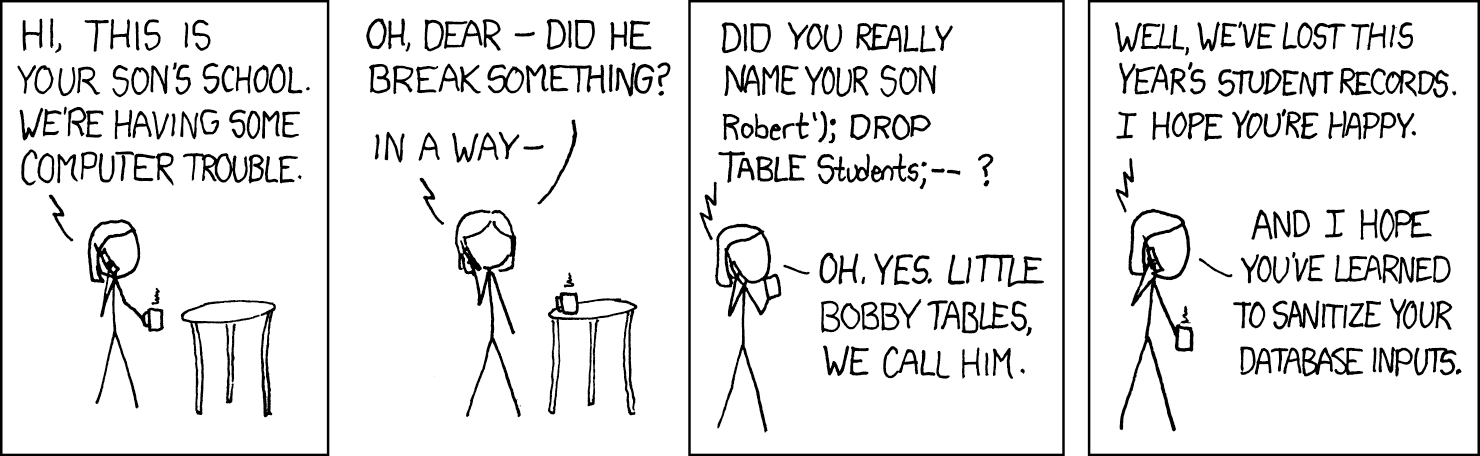
Except, it was little Bobby tables.

Conventions I have are:
- Downloads folder is ephemeral, don’t store/keep things in there I might want
- ~/scripts - personal scripts and one offs
- ~/Documents/projects/[subdir] - any tech project I may be working on, gets homed here
- /tmp - always mount it
noexec
I also start off allocating ~ 50GB to
/(root) volumegroup. Wine and proton have been taking up nearly the full space though, may need to expand it on my desktop soon.
 3·8 个月前
I’m a sell out that uses Spotify for modern and new music. I still have vinyls and a Garrand SL 95B for listening on. But I don’t buy many new vinyls lately, so it’s just the older music for that.





vim, mainly cause I haven’t figured out how to quit yet.